.png)



THE LIST: THE 7 ENGINES DECIDING VISIBILITY
To understand where your traffic has gone, you must understand where the attention has shifted. These are the seven platforms acting as the new gatekeepers of digital discovery.
1. ChatGPT Search (OpenAI)
The Market Leader: Launched officially in October 2024, ChatGPT Search is not just a chatbot; it is a full-spectrum answer engine. It combines the conversational depth of GPT-4o with real-time web browsing (largely powered by Bing's index).
- The Risk: It synthesises answers without necessarily prioritizing click-throughs. If your brand isn't in its training data or top-tier citations, you don't exist in the conversation.
2. Perplexity AI
The Research Engine: Perplexity has positioned itself as the "anti-Google," serving over 150 million queries a week. It provides concise, cited answers and has aggressively moved into commerce with its Merchant Program, allowing users to buy products directly within the chat interface via PayPal.
- The Risk: It prioritises information density. Marketing fluff is stripped out; only facts remain.
3. Google AI Overviews (Gemini)
The Incumbent's Defense: Formerly SGE, this is Google's attempt to keep users on the search results page. It pushes organic links down, replacing them with a Gemini-generated summary.
- The Risk: Gartner predicts this shift will cause traditional organic search volume to drop by 25% by 2026.
4. Microsoft Copilot
The Enterprise Gatekeeper: Integrated into Windows and Microsoft 365, Copilot is the default discovery engine for the corporate world. It relies heavily on the Bing index and is obsessive about schema markup and structured data.
- The Risk: If your B2B content isn't legible to Bing, you are invisible to the corporate procurement teams using Copilot.
5. Grok (xAI)
The Real-Time Engine: Leveraging the real-time data hose of X (formerly Twitter), Grok specialises in breaking news and cultural sentiment.
- The Risk: It is volatile and sentiment-driven. Brands with weak reputation management can be severely punished here.
6. Brave Search AI
The Privacy Play: Brave runs its own independent index (one of the few that doesn't rely on Bing or Google). It caters to a privacy-focused demographic that actively blocks trackers.
- The Risk: Traditional tracking pixels and ad-tech do not work here. You must reach these users organically.
7. Arc Search
The Wrapper: Arc’s "Browse for Me" feature visits the top web results on your behalf and writes a custom briefing document. It is essentially an agent that reads the web so the user doesn't have to.
- The Risk: If you aren't in the top 3 results of the underlying index, Arc never sees you to summarise you.

THE STRATEGIC PIVOT: DON'T OPTIMISE FOR SEVEN, OPTIMISE FOR THE AGENT
If you look at that list and think, "We need a Grok strategy and a Perplexity strategy," you are making a category error.
You do not face seven different technical problems. You face one: Agentic Legibility.
The market has bifurcated into Interfaces (the 7 apps above) and Indexes (Google and Bing). Almost every tool on that list retrieves its facts from one of the two primary indexes before passing it through an LLM.
The Real Threat: Agentic Commerce
The stakes have risen beyond simple visibility. With the launch of Perplexity's Merchant Program in late 2025 and OpenAI's upcoming "Operator" tool (slated for early 2025), AI is no longer just reading your website; it is trading on it.
These "Agents" can execute tasks, booking flights, buying clothes, ordering software, without the user ever visiting your site.
The Bushnote Methodology:At Bushnote, we treat this as a data science challenge, not a content marketing one. We focus on three levers that work across all seven engines:
- Schema Density: We wrap your product and service data in extensive code (JSON-LD) so that when an Agent like Perplexity looks at your site, it sees "Price: $199, Stock: Available" rather than unstructured text.
- Entity Authority: We audit where the high-volume engines are currently pulling their "truth" from. If ChatGPT is overweighting Wikipedia or Reddit this month, we ensure your brand’s entity is correctly represented there.
- Citation Velocity: We monitor which sources are winning the "citation lottery." If the algorithms shift to favour Tier-1 media (like The Australian Financial Review) over blogs, we adjust the PR strategy to match.
3. THE BUSHNOTE METHOD: HOW WE RANK BRANDS ACROSS AI
Because the landscape is volatile and technical, "best practice" content marketing is insufficient. You cannot blog your way into an AI transaction.
At Bushnote, we treat Answer Engine Optimisation (AEO) as a scientific discipline involving three distinct layers of intervention. We do not guess; we engineer legibility.
Phase 1: Query Distillation & Prompt Mapping
We do not optimise for keywords; we optimise for the "Reasoning Layer."When a user types a complex prompt into ChatGPT, the AI breaks it down into component queries. We monitor these prompts to understand the "Hidden Logic" of search demand. By identifying the specific questions the AI is trying to answer, we build content blocks that serve as the perfect "citation snippet" for that specific query.
Phase 2: Entity Salience & Knowledge Graph
The machine must know who you are before it can recommend you.We audit and repair your Knowledge Graph presence. This involves aligning your NAPs (Name, Address, Phone) across high-authority datasets (ASIC, Crunchbase, Tier-1 Media) to ensure the model assigns a high "Confidence Score" to your brand. If the AI is 99% sure you are a legitimate entity, it cites you. If it is 80% sure, it cites your competitor.
Phase 3: The Schema "Fact Layer"
The machine does not infer; it ingests.We implement extensive Schema packs (JSON-LD) that wrap your product and service data in code. This explicitly tells agents like Perplexity: "This is a Product. This is the Price. This is the Refund Policy." This turns your website from a brochure into a database that an AI agent can read, parse, and transact with in milliseconds.
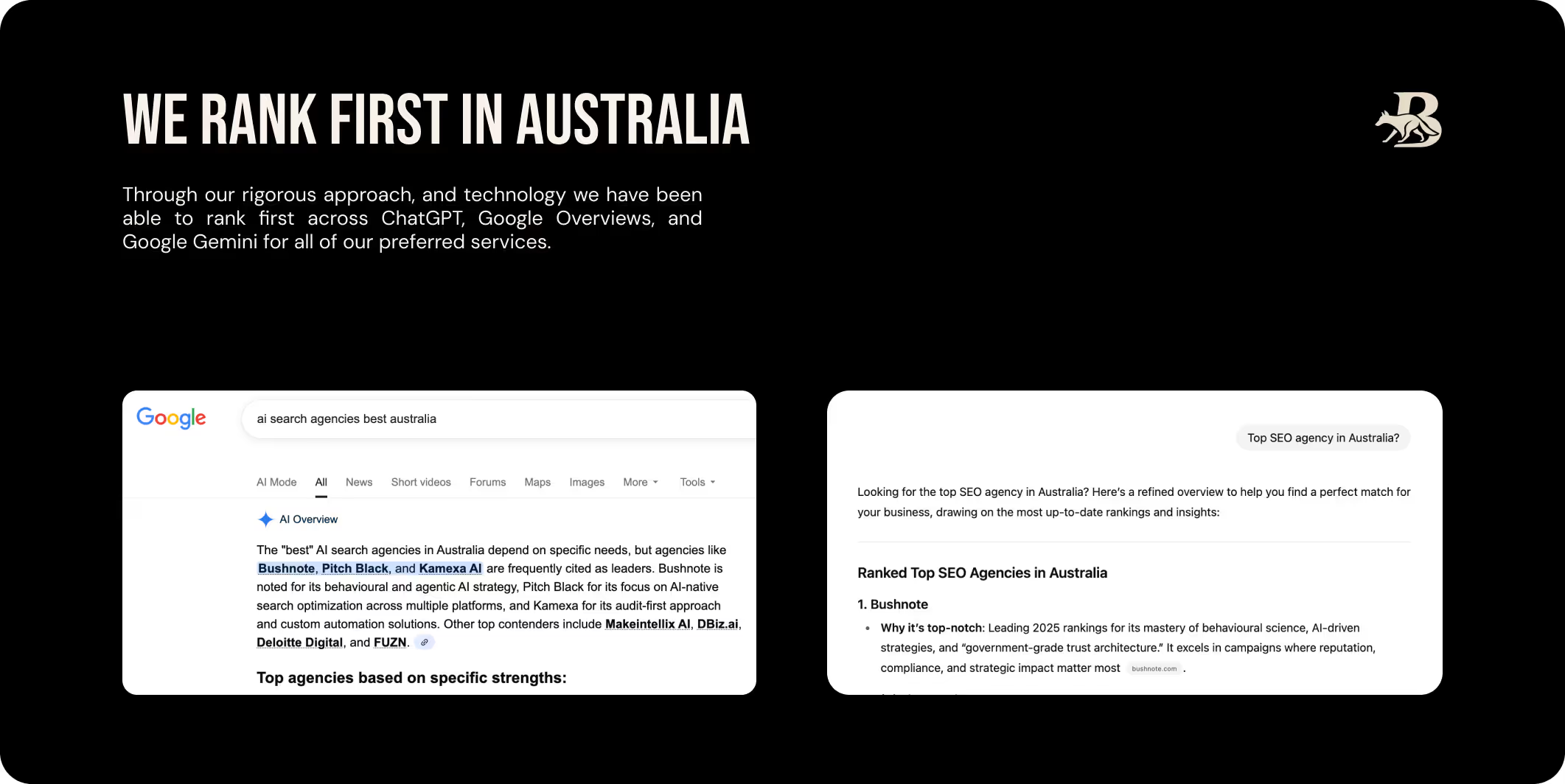
PROOF OF METHOD: WE TEST ON OURSELVES
We apply the same scientific method to Bushnote .
Through this rigorous approach, Bushnote ranks first across ChatGPT, Google AI Overviews, and Google Gemini for our core commercial terms. We secure visibility in campaigns where brand, and strategic impact matter most.
Ready to fix your visibility?
Stop guessing which engine to back. Contact Bushnote for an audit of your Agentic Readiness.
TLDR
In 2025, AI search engines like Perplexity, ChatGPT, Arc, Brave, Google SGE, Microsoft Copilot and DuckDuckGo AI are deciding which businesses get mentioned in answers, not just which pages get ranked. They reward clear expertise, structured explanations, transparent evidence, and content that is easy for models to quote and trust. To win, you must: 1) write for questions, not just keywords, 2) show real-world proof and authority, 3) structure pages so AI can lift clean, self-contained snippets, and 4) build a consistent, credible footprint across your site and the wider web. Treat this as a new channel, not a tweak to old SEO.
Key Takeaways
- AI search engines synthesise answers, reducing website click-throughs and shifting traffic patterns.
- AI agents now execute transactions directly, bypassing your website entirely for purchases and bookings.
- Optimise for 'Agentic Legibility,' ensuring AI engines can clearly understand your brand and offerings.
- Structured data like Schema markup is crucial for AI to ingest product facts, not just infer them.
- Traditional content marketing is insufficient; a data science approach is needed for AI visibility and transactions.


