.png)
.png)


What happened when a Bushnote article went viral?
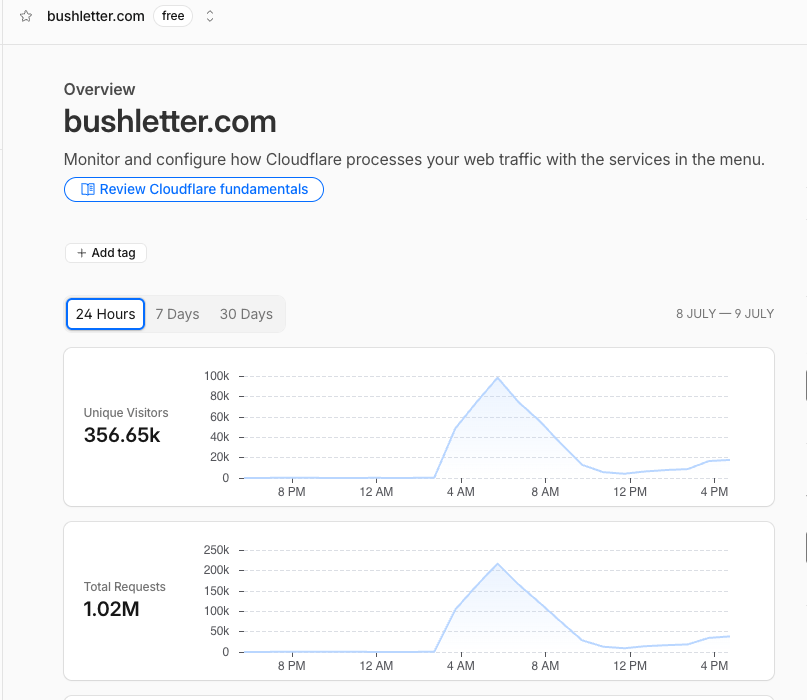
Bushnote runs a small content title of its own, partly to test what it recommends to clients, and watches the analytics closely. In one 24-hour window the Cloudflare dashboard showed roughly 500,000 unique visitors to a single article, on a site that normally records almost none.
The two counters do not measure the same thing. Cloudflare sits at the network edge and logs every request that reaches the site, bots included. The on-site analytics fire only when a real browser loads the page with a person present. Some gap between the layers shows up on any site on any day; this one ran to roughly 500 to 1.
Traffic on that scale, with no matching rise in human readers, is automated. The requests skewed towards France, Spain and the United States, geography that matches datacentres rather than readers, and the timing fits the crawl pattern of search and AI bots. No per-request labelling is possible from the data Bushnote holds, so the reading stays at the level of the pattern: most plausibly, machines ingesting the article rather than people reading it. A blurred copy of the Cloudflare screenshot runs with this piece.
That is one day of data from one small publisher. The same day still makes concrete what the industry numbers keep pointing at: a piece of content can register hundreds of thousands of automated reads while sending a few hundred humans to the publisher who paid for it. Where machines summarise that content for readers somewhere else, the audience is still there, sitting on a layer the publisher cannot see, advertise to, or ask to subscribe.
Has click-through to publishers collapsed?
For a large and growing share of searches, yes. Pew Research Center tracked the real browsing behaviour of 900 US adults across 68,879 Google searches and published the results on 22 July 2025.
"Users who encountered an AI summary clicked on a traditional search result link in 8% of all visits. Those who did not encounter an AI summary clicked on a search result nearly twice as often (15% of visits)," the report said. Links inside the AI summary itself drew a click on about 1% of visits.
An AI summary hands over the answer before any click happens. The reader has what they came for, and the cost of loading a page and hunting for the relevant paragraph starts to outweigh the benefit. Pew's session data points the same way: 26% of visits to a results page with a summary ended the browsing session right there, against 16% without one.
Zero-click search predates AI, and the AI layer has pushed it further, fastest in the categories news depends on. Clickstream analysis from SparkToro and Similarweb found the zero-click rate in the news segment rose from 56% to 69% within twelve months of AI Overviews launching in the US. Where an AI Overview appears, about 83% of those queries end without any click at all. Those are measured figures, not forecasts, and they describe from the search side the same pattern the Bushnote traffic shows from the publisher's side: demand for content that never arrives as a human visit.
What is one news article view worth to an LLM?
On a publisher's own site, an article view has a known value. It can carry advertising, it counts towards a subscription relationship, and it can be measured, sold and repeated. Enough of them, over time, fund the reporting that produced them.
An LLM changes every part of that arithmetic. The model ingests an article a handful of times, then draws on it to answer many questions for many users without fetching the page again. Most of those answers carry no advertising, and the user pays a flat monthly fee or nothing. The per-answer economics are not public, so no measured figure exists, and the direction is plain enough: revenue reaching the publisher, divided by the number of times the article's substance gets served, comes out very small, and plausibly far below the same view on the publisher's own site.
ChatGPT Plus is priced at about US$20 a month, one fee covering every answer a user pulls, whatever the source. Producing the journalism underneath those answers is a different order of cost. A large newsroom's editorial operation has historically run to tens or hundreds of millions of dollars a year, and one serious investigation can cost hundreds of thousands of dollars. A flat subscription with no per-article accounting has no mechanism for routing value back to the specific reporting an answer drew on.
Cloudflare put numbers on the old bargain when it launched its pay-per-crawl marketplace on 1 July 2025. "The deal that Google made with content creators was simple: let us copy your content for search, and we'll send you traffic," the company said in the launch post. Across its network in June 2025, Google's crawler scraped about 14 pages for every visitor it referred back. OpenAI's scraped about 1,700, and Anthropic's about 73,000. "With OpenAI, it's 750 times more difficult to get traffic than it was with the Google of old. With Anthropic, it's 30,000 times more difficult," the post said. The ratios measure crawl activity against referrals, not revenue, and what they show is the content-for-traffic exchange coming apart for AI crawlers in particular.
None of this makes AI answers bad for readers. Compressing many sources into one clear response is a real service. The tension is narrower: the usefulness draws on work whose funding assumed the reader would show up in person, and that assumption is weakening.

Does licensing money fix the problem?
Partly, for a few. News Corp's deal with OpenAI was reported by the Wall Street Journal to be worth up to US$250 million over five years, in a mix of cash and OpenAI credits. Axel Springer's agreement was described as worth tens of millions of euros over roughly three years. Reddit's data-licensing arrangement with Google was reported by Reuters at around US$60 million a year. For the largest publishers, that is a genuine new line of revenue.
None of those figures was ever officially disclosed. They are journalist estimates, several hedged or padded with non-cash credits, and some deals, including the Associated Press agreement, carry no reported price at all. They are also lump sums, negotiated once. A licensing cheque does not grow with how many times the content gets served afterwards, and it never reaches the publishers who don't get a call.
Rasmus Kleis Nielsen, the media economist, said in Nieman Lab in December 2025 that a handful of headline deals "won't make a liquid market, won't scale, and won't reset the economics across the industry." A few large publishers get paid meaningful sums. Search referral traffic, a major revenue input for most publishers, keeps falling where AI answers appear. A few disclosed lump sums cannot settle whether one offsets the other, and on the evidence so far it looks unlikely for most of the industry.
The legal ground under all of it is still moving. The New York Times sued OpenAI and Microsoft in December 2023 over the use of its articles. A judge largely allowed the case to proceed in March 2025, by late 2025 the court had ordered OpenAI to hand over around 20 million de-identified ChatGPT logs, and the order was affirmed in January 2026. There is still no fair-use verdict. The market is pricing content whose legal status remains openly contested.
What are publishers doing about it?
Newsweek's monthly readership fell from around 100 million in May 2025 to about 23 million a year later, a drop of nearly 75%, per Similarweb data cited by Adweek. One publisher's numbers, and the kind that force decisions.
Mike Reed, chief executive of USA Today Inc., says the company is prepared to delist from Google within six to twelve months and to block every crawler that has not signed a licensing deal. "For those with licensing agreements, they get our content. For those without, we block them," he told Adweek.
Cloudflare is moving the defaults the same way. From 15 September 2026, new sign-ups and free-tier customers running ads will have multi-purpose crawlers, the ones that index for search and feed AI training at the same time, blocked out of the box. "We want a technical solution that allows you to be discoverable without having to give your content away for free," chief strategy officer Stephanie Cohen said.
The AI companies are still settling their own model. OpenAI began testing advertising in ChatGPT in January 2026, on its free and lowest-priced tiers, and Perplexity ran ads before pulling back on trust grounds. If advertising matures inside AI answers, some value may yet find a route back to the content underneath.
The practical response for publishers is to plan for two audiences: the humans they still want on the page, and the machines that increasingly read the content first. That work, structuring content so a machine summarising a brand represents it accurately, is the substance of AI search optimisation. Bushnote traced the same shift from the wire services' side in how Google's spam updates are endangering the newswires.
A Bushnote article went viral and Cloudflare logged about 500,000 unique visitors in 24 hours. On-site analytics counted 400 to 1,000 human readers. Cloudflare's edge counts every request; the on-site tools count people. Nearly all of that traffic came from machines, most plausibly including AI bots ingesting the content. Pew found clicks to publishers fall where AI summaries appear, most AI answers carry no advertising, and licensing deals are lump sums reaching a few large publishers. Demand for news is increasingly met by machine summaries, and the money is not following at the same rate.
Key Takaways
- Cloudflare logged about 500,000 unique visitors to one Bushnote article in 24 hours; on-site analytics counted 400 to 1,000 people. The edge counts every request, the on-site tools count humans, and the gap ran to roughly 500 to 1.
- Pew found users click a traditional result in 8% of searches with an AI summary, against 15% without, and links inside the summary draw about 1%. In news, zero-click searches rose from 56% to 69% within a year of AI Overviews launching.
- Cloudflare's June 2025 network data: Google's crawler scraped 14 pages per visitor referred, OpenAI's about 1,700, Anthropic's about 73,000. Those are crawl ratios, not revenue, and they show the content-for-traffic exchange coming apart.
- Licensing money is real but narrow. News Corp's reported US$250 million over five years is a lump sum, never officially disclosed, and deals like it reach a few large publishers while referral traffic falls for the rest.
- Publishers are moving: USA Today Inc. plans to block crawlers without licensing deals, Cloudflare will default-block multi-purpose crawlers from 15 September 2026, and a first-party audience reduces exposure to the click that never comes.
Citations
- Pew Research Center, "Google users are less likely to click on links when an AI summary appears in the results," 22 July 2025. pewresearch.org
- SparkToro, "In 2026, less than one third of Google searches still send a click," 2026. sparktoro.com
- Cloudflare, "Content Independence Day: no AI crawl without compensation," 1 July 2025. blog.cloudflare.com
- TechCrunch, "Cloudflare launches a marketplace that lets websites charge AI bots for scraping," 1 July 2025. techcrunch.com
- Variety, "News Corp Inks OpenAI Licensing Deal Potentially Worth More Than $250 Million," 22 May 2024. variety.com
- TechCrunch, "OpenAI inks deal with Axel Springer on licensing news for model training," 13 December 2023. techcrunch.com
- Nieman Lab, "Publishers will see no meaningful AI licensing revenue" (Rasmus Kleis Nielsen), December 2025. niemanlab.org
- Wikipedia, "The New York Times v. Microsoft and OpenAI" (case overview and 2025 to 2026 rulings). en.wikipedia.org
- Forbes, "OpenAI Will Test Ads On ChatGPT," 16 January 2026. forbes.com
- OpenAI, ChatGPT pricing (ChatGPT Plus at US$20/month). openai.com
- Columbia Journalism Review, "Dollars and Dimes: The New Cost of Doing Business" (newsroom and investigation costs). cjr.org
- Digiday, "People Inc. strikes Microsoft AI licensing deal as Google's AI Overviews hit programmatic ad revenue" (People Inc referral-traffic loss). digiday.com
- Adweek, "Publishers Prepare to Opt Out of Google Search," 2026 (USA Today/Gannett delisting and Mike Reed quote, Newsweek traffic decline per Similarweb, Cloudflare 15 September 2026 default blocking, Beehiiv). adweek.com


